PhD Position Title
Development and control of a wire-based laser-directed energy deposition for 3D metal printing
Job Information
Organisation/Company: University of Ljubljana, Faculty of Mechanical Engineering
Department: Laboratory of Synergetics
Research Field: Engineering, Technology, Computer science
Researcher Profile: First Stage Researcher (R1)
Application Deadline: 10 Sept 2026
Offer Starting Date: 1 Oct 2026
Job Status: Full-time
Type of Contract: Temporary (4 years), fully funded under the “Young Researcher” Grant, covers gross salary (including medical and social insurance), fees, and a personal research grant to cover material and travel costs.
Job Description
The research work will be carried out at the University of Ljubljana (UL), Faculty of Mechanical Engineering (FME) within the Laboratory for Synergetics (LASIN) which specializes in laser additive technologies, systems and processes, as well as intelligent process control systems. The focus of the research will be on laser-directed energy deposition (DED-LB) processes, with a particular emphasis on direct laser wire deposition (DLD-Wire), and on the integration of machine learning, neural networks, and predictive control for real-time process optimization. DLD-Wire is one of the most promising technologies for manufacturing and repairing metal components due to its high material efficiency, low porosity, and capability to process challenging materials.
Experimental Work
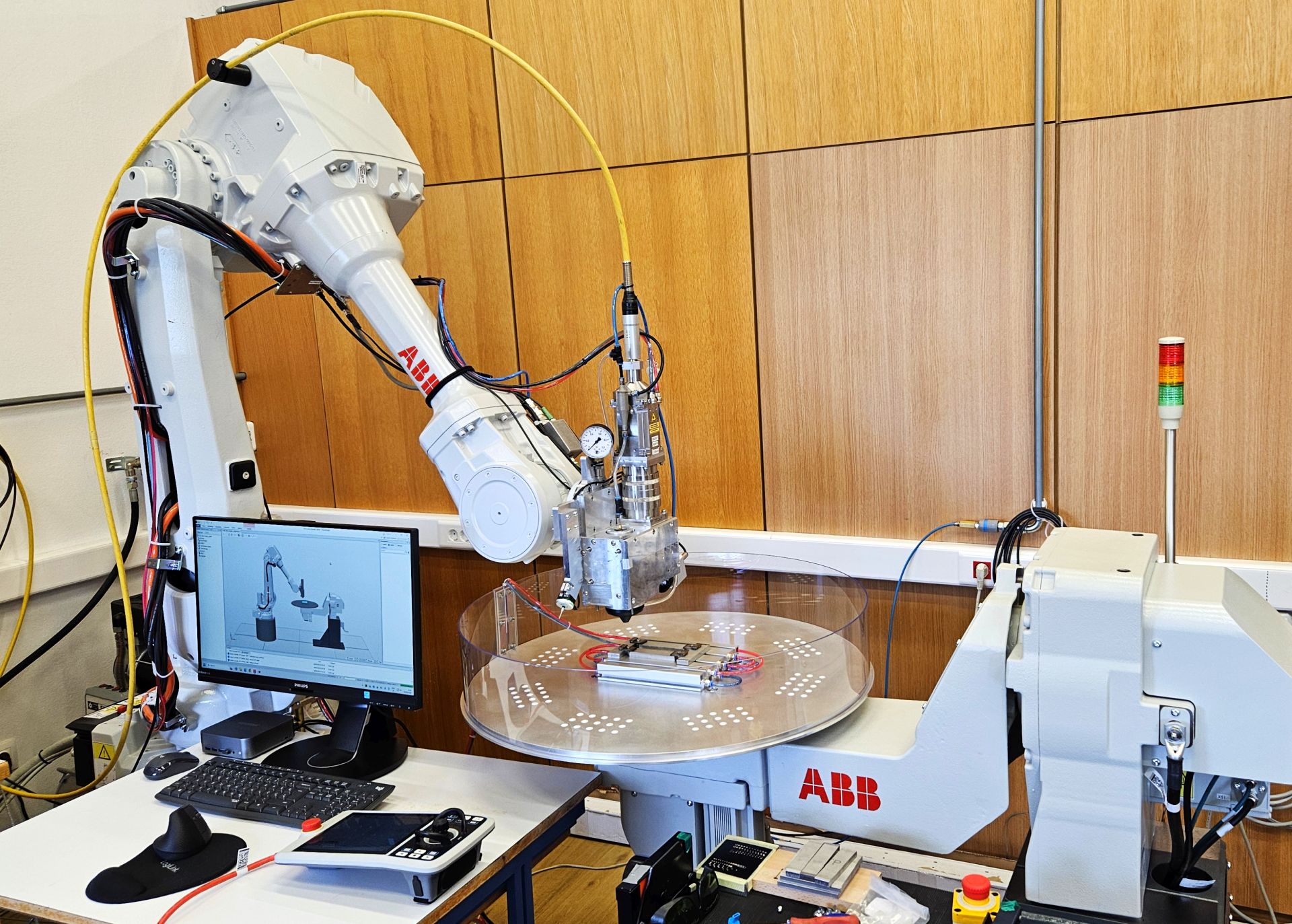
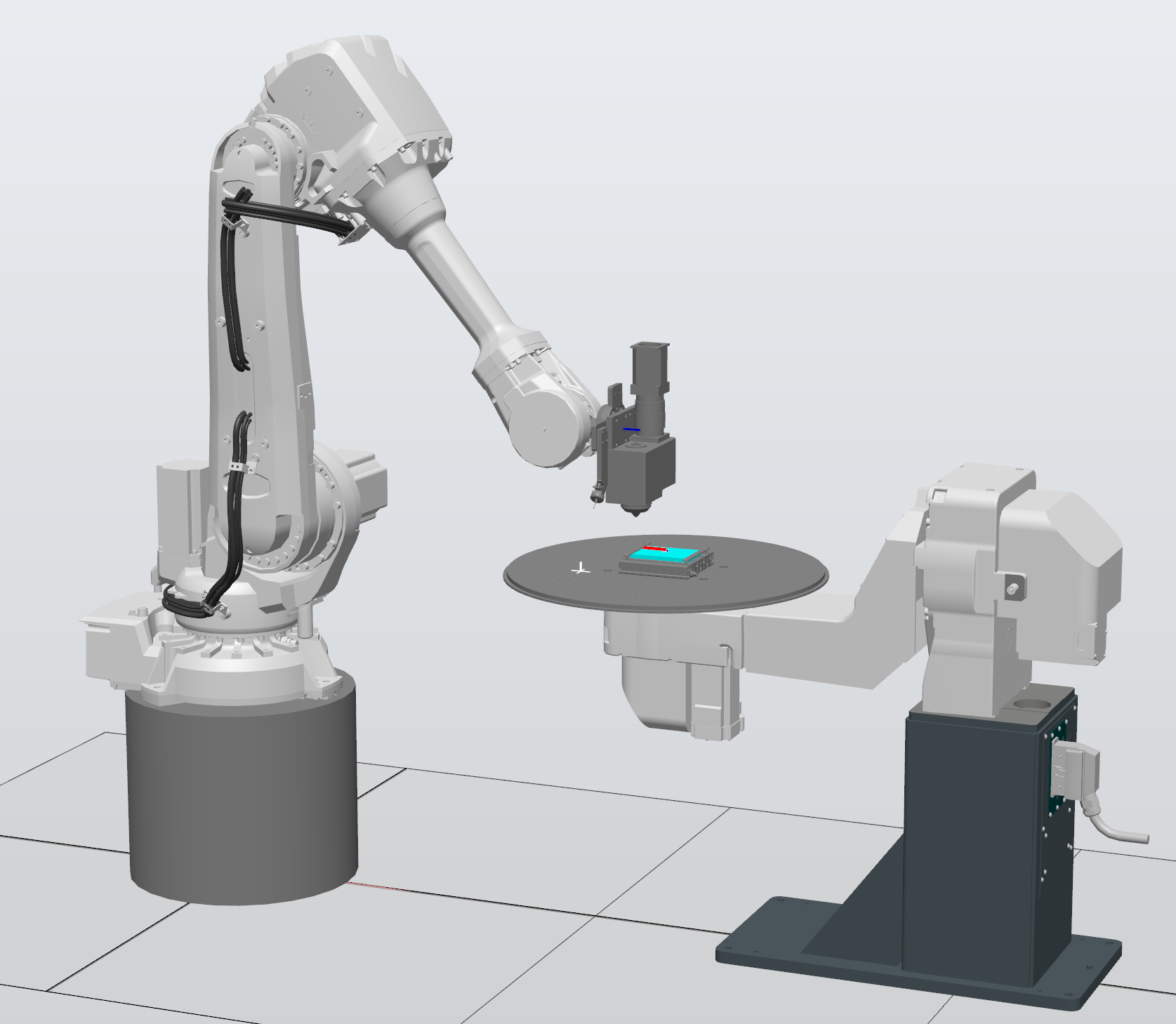
The experimental work will be carried out in the LASIN laboratory on an advanced robotic system for direct laser deposition (DLD) of metal wire, which includes:
- a 6‑axis ABB industrial robot,
- a dedicated RobotStudio environment for robot control,
- an in‑house developed laser head with an annular beam profile,
- a wire feeding system for metal wire,
- integrated process sensors for monitoring melt pool dynamics and deposition properties.
The candidate’s experimental tasks will include:
- technical upgrades of the system to support research experiments,
- development and implementation of process sensing (optical, IR, temperature, and other sensors),
- development of a wire‑feeding controller and synchronization with the laser source,
- planning and conducting experiments for a systematic analysis of process parameter influence on process stability and deposition quality,
- production of test samples with varying geometric complexity,
- analysis of dimensional accuracy, microstructure, and mechanical properties of the manufactured parts.
Research Objectives
The main objectives of the doctoral research are:
- development of innovative methods for improving DLD process stability,
- development of adaptive real‑time process control,
- improving dimensional accuracy, repeatability, and metallurgical quality of the products.
Special emphasis will be placed on:
- data‑driven process modeling,
- development of a digital twin of the DLD process,
- identification of critical process parameters,
- integration of artificial intelligence methods into closed‑loop process control,
- defining measurable metrics of process stability and quality.
Main Tasks of the Doctoral Candidate
- Research, modeling, and experimental validation of the direct laser wire deposition process.
- Identification of key process variables and development of a system for their real‑time measurement and diagnostics.
- Optimization of process parameters (laser power, wire feed speed, robot travel speed, beam caustics, etc.) to achieve process stability.
- Planning optimal material deposition paths according to part geometry and minimizing defects (overdeposition, porosity, deviations).
- Development of machine learning methods (regression models, neural networks, hybrid physics‑informed/data‑driven models) for predicting process stability and deposition quality.
- Implementation of predictive/adaptive real‑time process control.
- Programming of the robotic system (ABB, RAPID).
- Planning and execution of experiments and analysis of results.
- Preparation and publication of scientific papers in international journals (at least two papers in Q1 or Q2 journals).
- Active participation in international conferences and involvement in international research projects.
Required Qualifications
- Completed master’s degree in mechanical engineering, mechatronics, metallurgy, computer science, or related technical fields.
- Candidates must have a minimum average MSc grade of 80%.
- Basic understanding of laser additive processes or advanced manufacturing technologies.
- Knowledge of basic machine learning methods, numerical modeling, or systems control.
- Appreciated experience with software tools such as Python, MATLAB, ANSYS, SolidWorks.
- Appreciated experience with ABB RobotStudio and programming in RAPID.
- Mechatronic skills (developing and maintaining electronic and mechanic systems/compononets)
- Skills in experimental data processing and statistical analysis.
- Proficiency in English (written and spoken).
- High level of research curiosity, independence, and analytical thinking.
- Ability to write scientific texts and prepare publications in an international environment.
Additional Information
Job application
The official “Call to Tender for Young Researchers in 2026” is available here:
https://www.uni-lj.si/en/university/public-announcements/second-call-yr-2026
Interested candidates are invited to contact directly Assist. Prof. Dr. Primož Potočnik (see contact below) by e-mail prior to submitting the official application. Early contact is recommended in order to discuss the research topic, candidate suitability, background knowledge, and potential doctoral study enrollment. Applicants should send the documentation as requested by the official “Call to Tender for Young Researchers in 2026”.
After the initial evaluation and mutual agreement, selected candidates will be invited to submit the official application through the University of Ljubljana online application system within the framework of the official Young Researcher call.
According to the regulations of the Young Researcher Program, candidates applying for the position must be enrolled in an accredited doctoral study program. Doctoral enrollment is a formal requirement for the application procedure; however, enrollment does not obligate the candidate or the institution in the event that the candidate is not selected.
Benefits
We offer a full-time doctoral candidate position until the end of the four-year PhD study program, subject to a positive evaluation by the doctoral committee at the end of the second year. Remuneration will be according to the Slovenian laws and includes generous benefits in addition to Slovenian’s strong social supports.
You will receive advanced training in additive manufacturing (AM) and post-processing technologies. Your research will focus on laser-based AM processes and technologies. As a PhD student at FME, UL, in the Production Engineering Sciences, Cybernetics and Mechatronics study program, you will be employed at FME, UL in the Laboratory of Synergetics and will do the PhD study and research work under the supervision of Asst. Prof. Primož Potočnik. You will have the opportunity to acquire a range of skills suitable for both academic and industrial careers. In addition, you will have the freedom to shape the project as you develop academically and take advantage of the excellent research environment at FME, UL to realize your own ideas within the context of the PhD research project.
You will receive support to attend European and other international conferences and to publish your scientific achievements in respected scientific journals. In addition, you will receive career guidance and be encouraged to develop skills for science-related careers.
Slovenia is a safe country with a high standard of living. It is known for its beautiful nature and good food. Some attractions such as the Adriatic coast, hiking trails, and alpine ski resorts are within an hour from Ljubljana. More information about Slovenia: https://www.slovenia.info/en
We offer
- Full-time position
- Flexible working hours and the possibility to work from home
- Good balance between personal and professional life
- Excellent team spirit
- Basic salary €1300 net. The salary in Slovenia includes basic health insurance, social security, and a pension plan.
Work location
Faculty of Mechanical Engineering
Laboratory of Synergetics
Aškerčeva 6
1000 Ljubljana
Slovenia
Eligibility criteria
We are looking for an enthusiastic, creative, and communicative researcher with a Master’s degree in Mechanical Engineering, Mechatronics, Computer Science, Materials and Metallurgy, Electrical Engineering, Physics, or related fields. The candidate should have a strong interest in conducting scientific research. The candidate should have a record of excellence (outstanding grades and/or publications) during study and should be pursuing a PhD degree within four years.
References
A few selected references to our previous research on DED-LB processes:
- Minimizing part deformation in laser deposition by evolutionary optimization of laser beam path. Engineering computations, 2025, DOI: 10.1108/EC-09-2024-0886.
- Influence of the laser-beam intensity distribution on the performance of directed energy deposition of an axially fed metal powder. Journal of materials processing technology, 2024, DOI: 10.1016/j.jmatprotec.2024.118360.
- Genetic algorithm-based framework for optimization of laser beam path in additive manufacturing. Metals, 2024, DOI: 10.3390/met14040410.
- Powder particle–wall collision-based design of the discrete axial nozzle-exit shape in direct laser deposition. Journal of materials processing technology, 2022, DOI: 10.1016/j.jmatprotec.2022.117704.
- Advances in the understanding of the annular laser beam wire cladding process. Journal of materials processing technology, 2021, DOI: 10.1016/j.jmatprotec.2021.117105.
Contact
Assist. Prof. Dr. Primož Potočnik
University of Ljubljana, Faculty of Mechanical Engineering
Laboratory of Synergetics
Aškerčeva 6, SI-1000 Ljubljana, Slovenia
T: +386.1.4771.605
primoz.potocnik@fs.uni-lj.si
https://web.fs.uni-lj.si/lasin/en/primoz-potocnik